

How to Identify the Sugar Maple, Eastern Canada’s Iconic Tree Known for Its Syrup
Spring in Eastern Canada is closely tied to maple syrup season—especially in Quebec. In early spring 2024, with an unusually early start influenced by El Niño, maple sugaring is already underway across the province’s sugar bushes.
Quebec plays a major role in global maple syrup production, producing approximately 70–80% of the world’s supply. Its climate and growing conditions are ideal for sugar maple, making it a global leader in this industry.
A Quick Overview of the Acer Genus (Maples)
There are about 130 maple species worldwide, grouped into three main regions: American, European, and Asian.
Of these, 13 species are native to North America, including 10 found in Canada.
In Ontario and Quebec, six maple species are native: Sugar Maple (Acer saccharum), Red Maple (Acer rubrum), Silver Maple (Acer saccharinum), Black Maple (Acer nigrum), Striped Maple (Acer pensylvanicum), and Mountain Maple (Acer spicatum). Of these, the first four produce sweet sap and are considered sugar-producing maples.
Let’s take a closer look at how to identify them.
Maples: Look at the Leaves to Identify the Species

The most reliable way to distinguish between the four sugar-producing maple species is by observing their leaves.
Characteristics such as size, number of lobes, depth and shape of the sinuses, margins, and colour allow for clear identification.
Sugar Maple (Acer saccharum)

Sugar maple leaves are the largest, measuring 8 to 20 cm wide. They typically have five deep lobes with rounded sinuses. The surface is smooth and glossy. In spring and summer, leaves are dark green above and lighter underneath. In fall, they turn brilliant shades of yellow, orange, and red.
Red Maple (Acer rubrum)

Red maple leaves are the smallest, measuring 5 to 10 cm wide. They usually have three lobes with sharp sinuses and finely serrated edges. They often display reddish tones, especially in spring and fall. Autumn colour ranges from bright red to orange or yellow. The underside is typically lighter.
Silver Maple (Acer saccharinum)

Silver maple leaves are medium-sized (8 to 15 cm wide), with 3 to 5 lobes and deep, sharply defined sinuses. A distinctive feature is their silvery underside. The upper surface is light green in summer, turning yellow in fall.
Black Maple (Acer nigrum)
Black maple leaves are also medium-sized (8 to 15 cm wide), with 3 to 5 lobes and moderately deep sinuses. They are less deeply cut than sugar maple leaves. The foliage is dark green with a slightly drooping appearance, and the underside shows fine hairs (pubescence). Fall colour is typically golden yellow, sometimes with orange or red tones.
Advanced Identification Features for Maple Enthusiasts
Maple Bark
Bark colour and texture can also help identify maple species, although this requires some experience. These characteristics vary with age and growing conditions, so they should be used alongside other features.
| Sugar Maple | Red Maple | Silver Maple | Black Maple |
| Light to dark grey. | Smooth, grey to brownish. | Light grey to silvery-grey, sometimes whitish. | Dark grey to nearly black. |
| Smooth when young, developing shallow ridges over time. | May develop shallow fissures. | Often smooth, becoming slightly fissured with age. | May develop deep fissures early; older bark may peel slightly. |
Winter Buds
In winter, when leaves are absent, terminal buds can also help differentiate species, although close observation is required.
| Sugar Maple | Red Maple | Silver Maple | Black Maple |
| Small and pointed. | Larger and more rounded. | Long and slender. | Slightly smaller and somewhat pointed. |
| Reddish-brown to dark brown. | Reddish-brown to dark brown. | Light to dark brown. | Dark brown to nearly black. |
| Slightly sticky. | May be slightly hairy. | Smooth and glossy. | May be slightly hairy. |
Maple Samaras
Maple fruits, known as samaras or "helicopter seeds", are useful clues for identifying maple species. One key difference is when they fall: some maples release their samaras in spring, while others wait until fall.
Silver maple samaras are among the first to fall, usually in May. Larger than those of sugar maple, they measure about 3 to 5 cm long and grow in clusters. Their broad, well-developed wings range from light to medium brown, sometimes with a silvery tint.
Red maple samaras follow in late spring or early summer, typically around June. Smaller than sugar maple samaras, they measure approximately 1 to 2 cm long. They grow in clusters, with relatively small, less distinct wings that are usually reddish or brown.
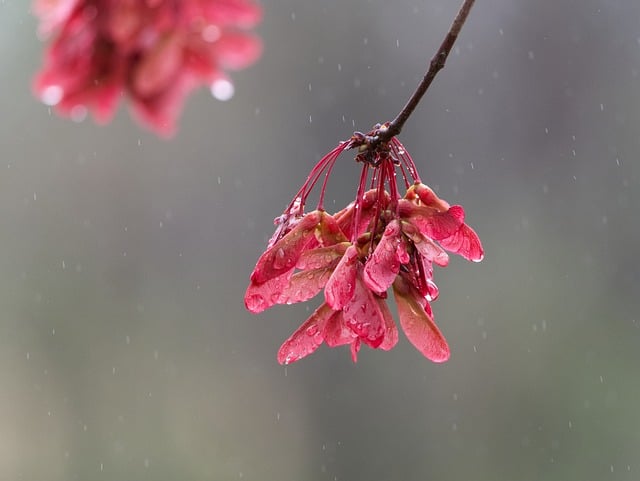
Sugar maple and black maple release their samaras in fall. Distinguishing between these closely related species takes a trained eye!
Sugar maple samaras measure approximately 2 to 3 cm long. They grow in clusters and have two well-developed wings that form an angle of about 60 degrees. Their colour ranges from light to dark brown.
Black maple samaras are generally smaller, measuring 1 to 2 cm long. Like those of sugar maple, they grow in clusters, but their wings are smaller and less distinct. Their colour ranges from dark brown to nearly black.
Sugar Maple: The Sweet Sap Champion Has Some Competition

Most maple syrup comes from the sap of sugar maples, the dominant trees in Quebec's traditional sugar bushes. But did you know that three other native maple species also produce sap suitable for making syrup?
These are red maple, black maple and silver maple. Together with sugar maple, they belong to a group commonly referred to as syrup-producing maples.
Sugar maple produces the sweetest sap, although few studies have compared the profitability of tapping different species. Within the maple syrup industry, red maple, commonly called plaine in Quebec, is also recognized for its good results.
Black maple is so closely related to sugar maple that some botanists question whether it should be classified as a separate species. In Quebec, it reaches the northern limit of its natural range and is found mainly along the Ottawa River, in the Eastern Townships, Montérégie and the Greater Montreal area.
Silver maple produces less concentrated sap but can still be tapped for syrup. A pioneer species adapted to very wet environments, it thrives where other maples often struggle.
The Right Maple for the Right Habitat
Each of these four maple species occupies a distinct ecological niche, meaning the environmental conditions that allow it to survive and reproduce. Understanding these preferences helps explain where each species naturally grows.
Sugar maple thrives in rich, deep, fertile and well-drained soils. Although widespread in our forests, its low tolerance for pollution has limited its use as a street tree in urban areas.
Red maple is the most adaptable of the four, growing in a wide range of soils while favouring moist, well-drained conditions. It also has the northernmost distribution. Its versatility makes it a popular choice for urban landscaping.
Silver maple prefers wet environments and naturally grows along streams, rivers and wetlands. It tolerates various soil types and was widely planted along city streets in the past. Today, it remains a familiar part of many urban landscapes.
Black maple shares sugar maple's preference for rich, deep, fertile and well-drained soils. Their ecological niches overlap considerably, allowing the two species to grow together and hybridize naturally.
Why Not Make Your Own Maple Syrup?
Have one or more syrup-producing maples on your property? Why not try making your own maple syrup? Chances are you know someone with a sugar bush who could lend you a few taps and collection buckets!
On average, it takes 40 litres of maple sap to produce 1 litre of syrup. It's a fun and rewarding activity for the whole family!


