

Fir or Spruce: What Are the Differences?
Are you someone who walks through the forest, spots a beautiful conifer, and wonders whether it’s a fir or a spruce? Or perhaps you’re shopping for a Christmas tree and questioning whether you’re being sold a spruce instead of a fir? Either way, you’ll be glad to know that distinguishing these majestic trees—kings of Canada’s mixed and boreal forests—is easier than you might think.
Fir (Abies spp.) and spruce (Picea spp.) both belong to the Pinaceae family. They share many similarities: both are conifers with evergreen needles and a pyramidal growth habit. They are native to the Northern Hemisphere and thrive in cold climates. It’s no surprise they are often confused!
Fortunately, there are several reliable ways to tell firs and spruces apart: by their cones, bark, needles, and branch structure.
Cones Pointing Up or Down?
Observing cones is one of the quickest and most reliable ways to distinguish firs from spruces. If cones are hard to spot, look near the top of the tree, where they are most abundant—or check the ground below.
Upward Cones? Fir
Firs produce upright cones that remain attached to the tree even when mature, gradually disintegrating to release seeds. As a result, you will find few or no cones on the ground.

Downward Cones? Spruce
Spruces, on the other hand, bear cones that hang downward and fall intact once mature. These cones are generally smaller, more rigid, and often found in large numbers on the ground beneath the tree.

Distinct Bark Characteristics
While similar in young trees, bark becomes more distinctive with age.
Fir bark is generally smooth and grey when young, becoming more fissured and scaly over time. It also produces resin (balsam), which can make the trunk sticky.
Spruce bark is typically rougher and scaly, often peeling in small plates. As the tree ages, it develops deeper fissures and a more rugged texture.
A simple mnemonic: if the bark has scales that peel, it’s a spruce.
Do the Needles Roll… or Not?
You may have heard the trick of rolling a needle between your fingers. While not foolproof, it can help. Fir needles are flat and generally do not roll easily. Spruce needles, with their typically four-sided structure, will roll between your fingers.
You can also observe how needles are arranged. Fir needles are usually arranged in neat rows, giving branches a flattened appearance. Spruce needles grow all around the twig, creating a fuller, radial look. However, this can be harder to assess in cultivated varieties.
A more reliable method: run your hand along a branch against the grain. Spruce needles are sharp and prickly, while fir needles are soft and smooth.
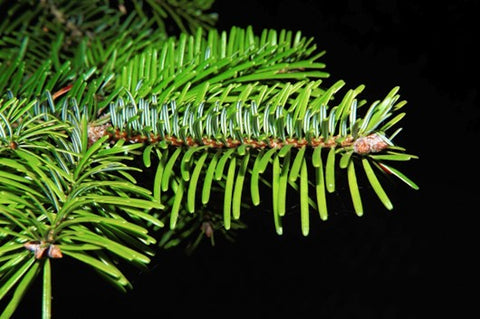

- Sharp, prickly needles: spruce!
- Soft needles: fir!
Do Firs and Spruces Grow in the Same Habitat?
Yes, both can coexist, depending on climate conditions. In Ontario and Quebec, both species are naturally found up to Zone 3. Further north, only spruces dominate.
- Firs prefer moist, fertile soils and temperate climates, often found in mixed forests or sheltered mountain slopes.
- Spruces are more tolerant of harsh conditions, including poor soils, colder climates, and exposed sites. They are characteristic of boreal forests and can grow as far north as Zone 1.
What About Pines and Larches?
Pines and larches both have needles grouped in bundles (fascicles), making them easy to distinguish with a few observations.
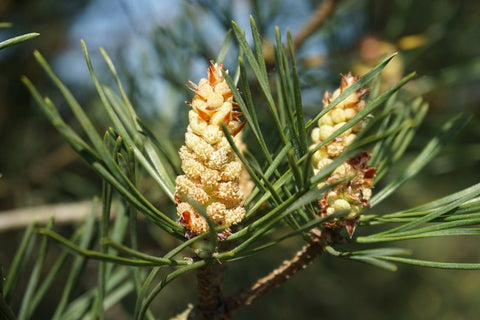
Pines have long, slender needles grouped in bundles of 2, 3, or 5 depending on the species. For example, red pine (Pinus resinosa) has needles in pairs, while eastern white pine (Pinus strobus) has bundles of five.
Larch needles, on the other hand, are short, soft, and grouped in clusters of 10 to 20. Unlike most conifers, larches are deciduous—they lose their needles in fall. In winter, only their small rose-like cones remain.
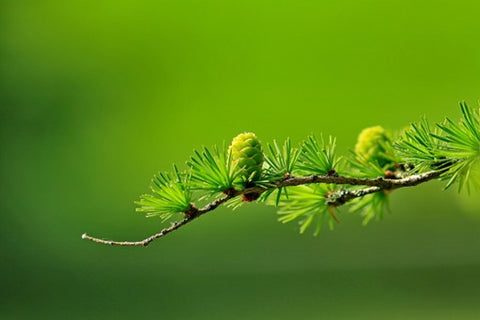
Short, clustered needles on larch
A Tool to Help Identify Eastern Canada's Conifers
If you’d like to go further, Flora Quebec offers a simple conifer identification key:
Key Characteristics of Common Native Conifers in Eastern Canada
A solid understanding of conifers supports sustainable resource management, biodiversity conservation, and successful horticulture and forestry practices.
Balsam Fir (Abies balsamea)
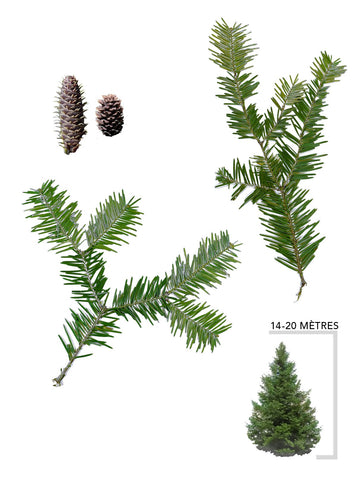
Balsam fir is a conical tree reaching 14–20 metres. It has flat, aromatic needles and upright cones. It prefers moist, acidic soils and is widely used as a Christmas tree.
White Spruce (Picea glauca)
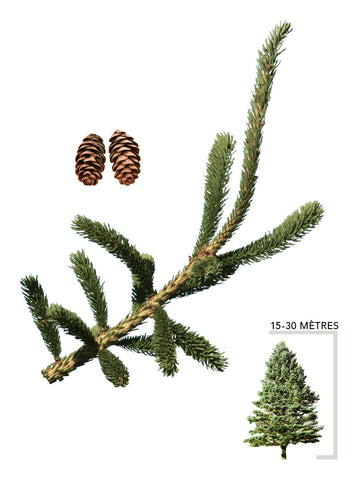
White spruce can reach 30 metres. It has sharp needles and pendulous cones, thriving in cold climates and well-drained soils.
Red Spruce (Picea rubens)
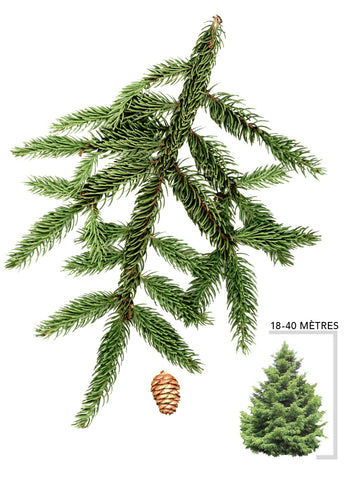
Red spruce grows up to 30 metres, with short, sharp needles and reddish bark. It prefers acidic, moist soils.
Eastern White Pine (Pinus strobus)

This large conifer features long, soft needles in bundles of five and prefers well-drained, sunny sites.
Tamarack (Eastern Larch) (Larix laricina)

Tamarack is a deciduous conifer adapted to wetlands and peatlands. Its soft needles turn golden before dropping in fall.
Enhancing Biodiversity with Conifers
Native conifers in Eastern Canada are both majestic and ecologically valuable. Incorporating them into landscapes helps maintain year-round greenery, restore habitats, and support biodiversity by attracting wildlife.


